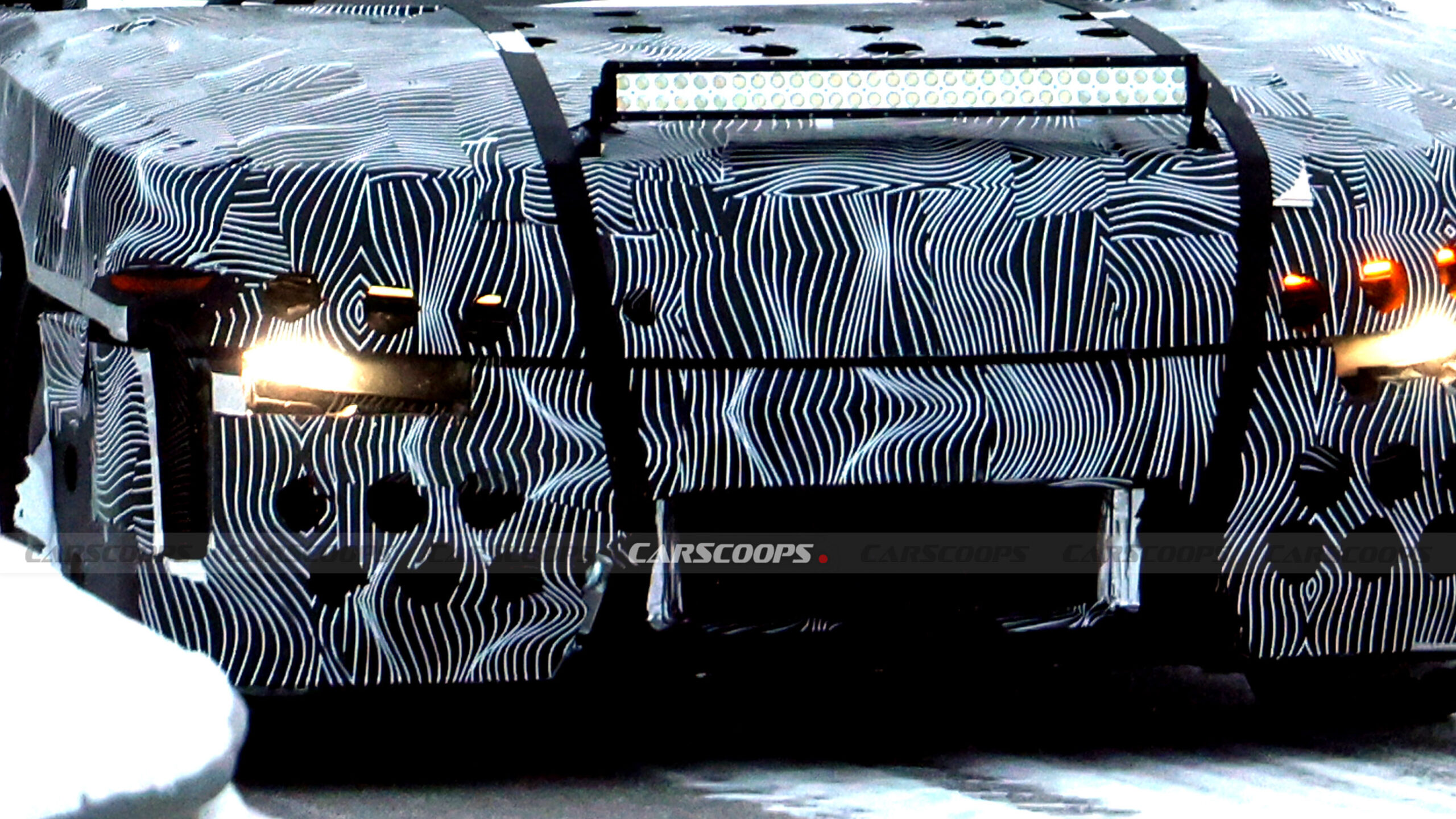
For seventy-eight years, every Ferrari ever built has been powered by internal combustion. Flat-planes screaming past 8,000 rpm. V12s that shake the ground. The kind of mechanical violence that turned a small Italian company into the most valuable luxury brand on the planet. And now, for the first time in history, Maranello is about to release a car with no engine at all.
The Ferrari Luce — Italian for "light" — is Ferrari's first fully electric production car. Not a hybrid. Not an experiment. A four-door, four-seat electric grand tourer with over 1,000 horsepower, an interior designed by the man who created the iPhone, and a sound system that refuses to fake what it isn't. Full reveal is set for May 25, 2026 in Rome.
Three-Stage Launch: How Ferrari Built the Suspense
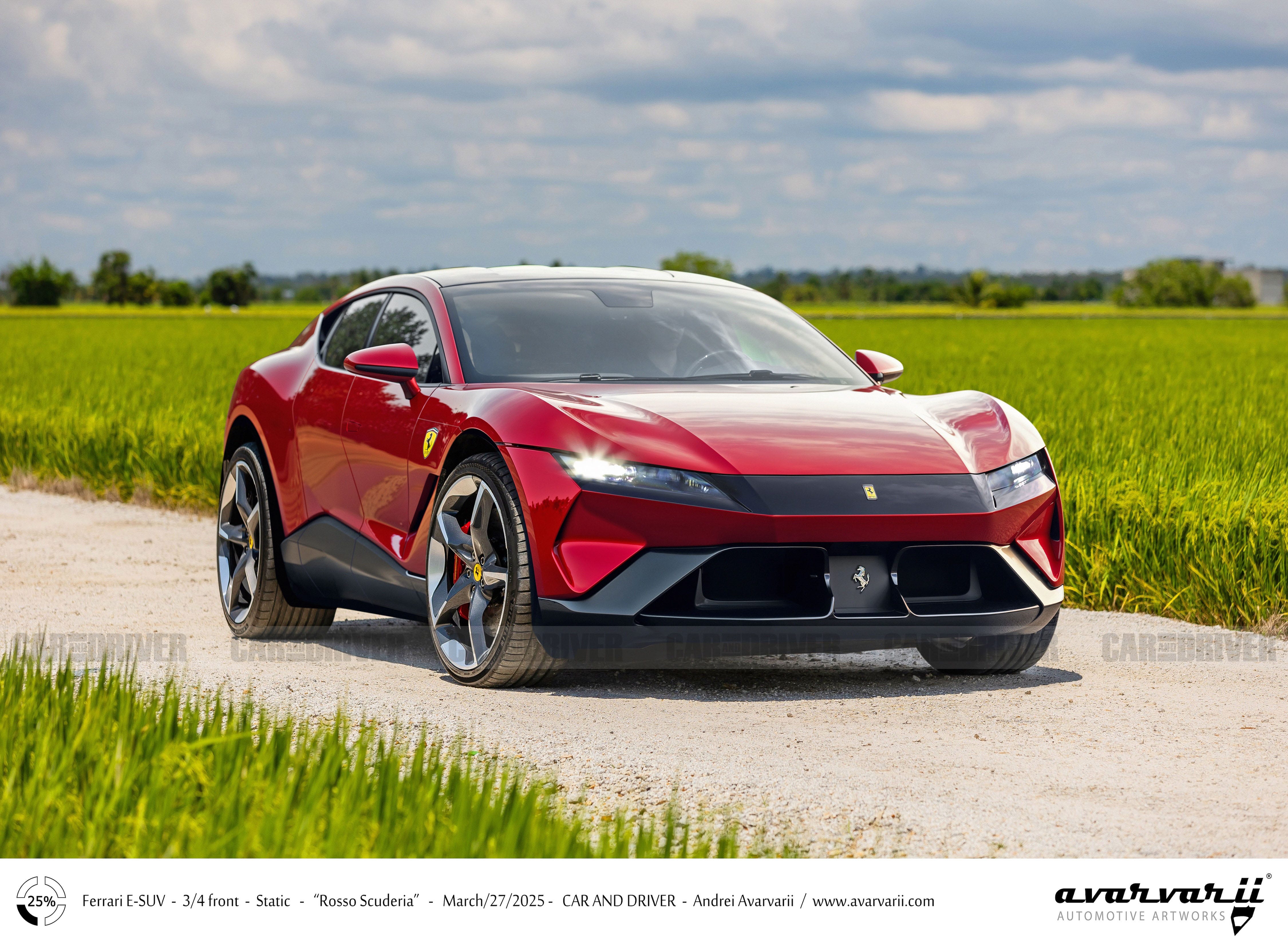
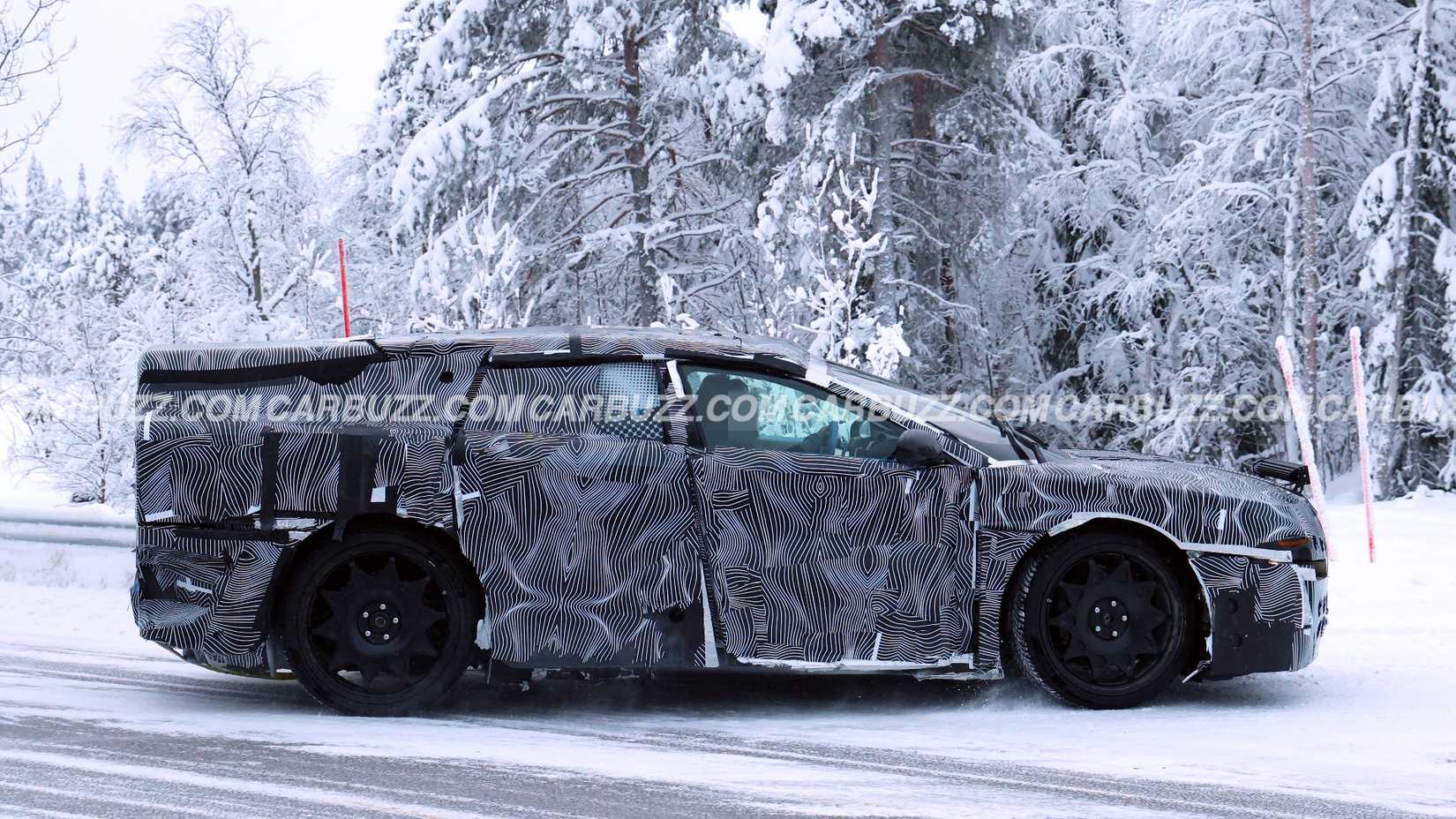
Ferrari unveiled the Luce the way it launches its most exclusive special editions — in three calculated stages. In October 2025, during Capital Markets Day, they revealed the powertrain, battery architecture, and chassis technology. In February 2026 in San Francisco, they dropped the official name (replacing the codename "Elettrica") and showed the interior for the first time. The full exterior design remains under wraps until May 25, 2026, when the complete car will be revealed at a dedicated event in Rome.
As Ferrari CEO Benedetto Vigna stated: "This is an addition to the lineup, not a transition." The Luce will coexist with V12s, V8s, and hybrids. Ferrari's 2030 strategy calls for 20% electric, 40% hybrid, and 40% combustion in its annual sales.
Quad-Motor Powertrain: 1,000+ HP, All In-House
The Luce's powertrain was developed entirely in-house at Maranello — no borrowed motors, no outsourced technology. Four permanent-magnet synchronous electric motors, one at each wheel, use a Halbach array magnet configuration borrowed directly from Ferrari's F1 powertrains, achieving 93% efficiency.
The numbers are staggering. The two rear motors deliver 416 HP each (843 HP combined at the rear axle with 8,000 Nm to the wheels). The two front motors add 141 HP each (286 HP combined with 3,500 Nm). In Boost mode, total output exceeds 1,000 HP — some sources cite 1,113 HP — available in less than one second. Rear motors spin to 25,500 rpm, fronts to 30,000 rpm, eliminating the need for a two-speed gearbox.
During cruising, the front motors disconnect completely to maximize efficiency. When you bury the throttle, they reconnect instantly. The result: 0–100 km/h in 2.5 seconds, a top speed of 310 km/h, and a quarter mile in under 10 seconds.
880-Volt Battery: 530 km Range, 350 kW Charging
The 122 kWh NMC lithium-ion battery operates at 880 volts — one of the highest architectures in any production car. Comprising 210 cells across 15 modules, it is structurally integrated into the carbon fibre chassis, lowering the centre of gravity while adding rigidity. Battery cells are supplied by Korean manufacturer SK On, with final assembly in Maranello.
Energy density reaches 280 Wh/kg at cell level — a record for liquid-electrolyte technology. WLTP range exceeds 530 km (approximately 280 miles EPA). DC fast charging supports up to 350 kW, with 10–80% taking under 25 minutes. Weight distribution sits at 47% front, 53% rear — deliberately rear-biased, as every Ferrari should be.
Interior by Jony Ive: The Man Who Killed Buttons Brings Them Back
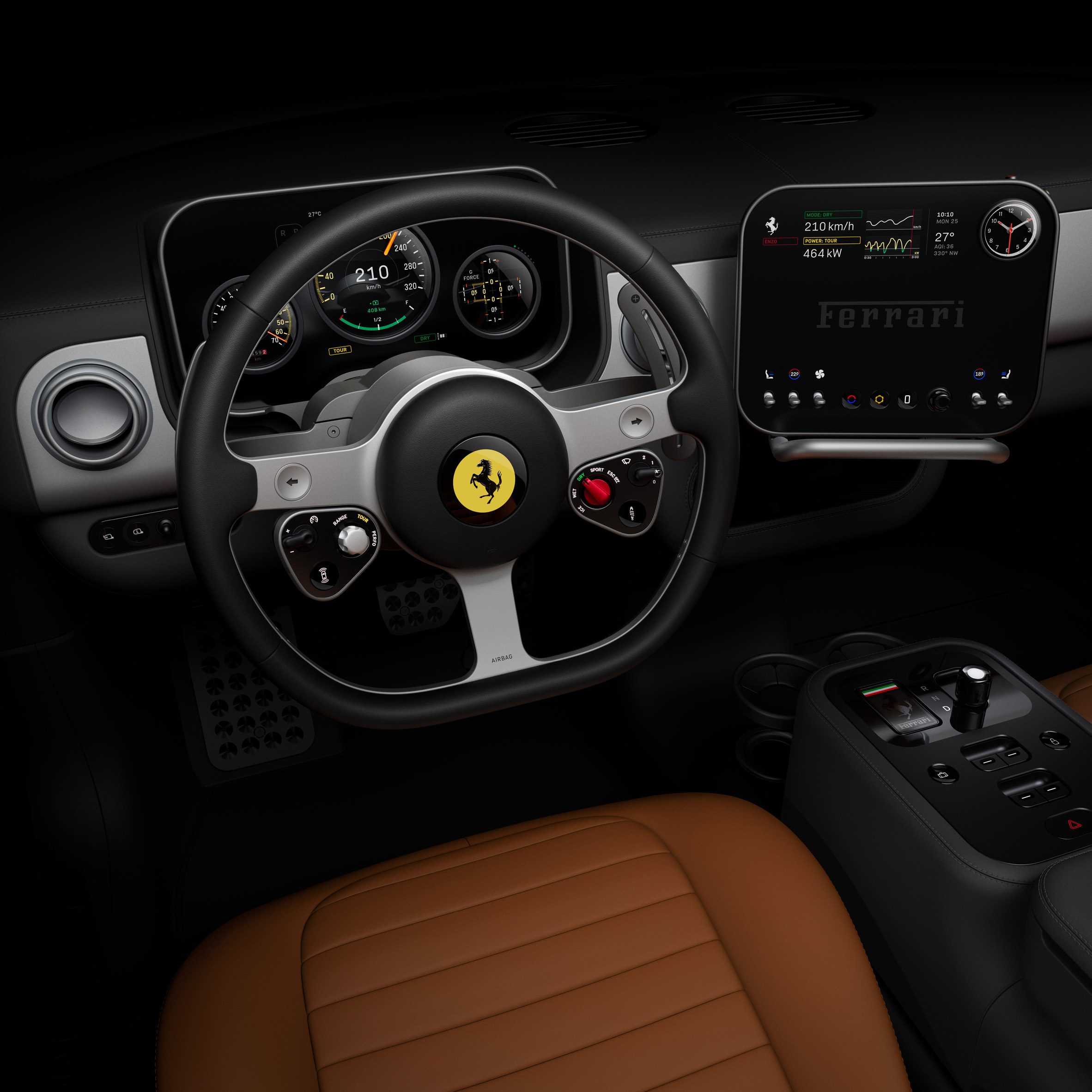
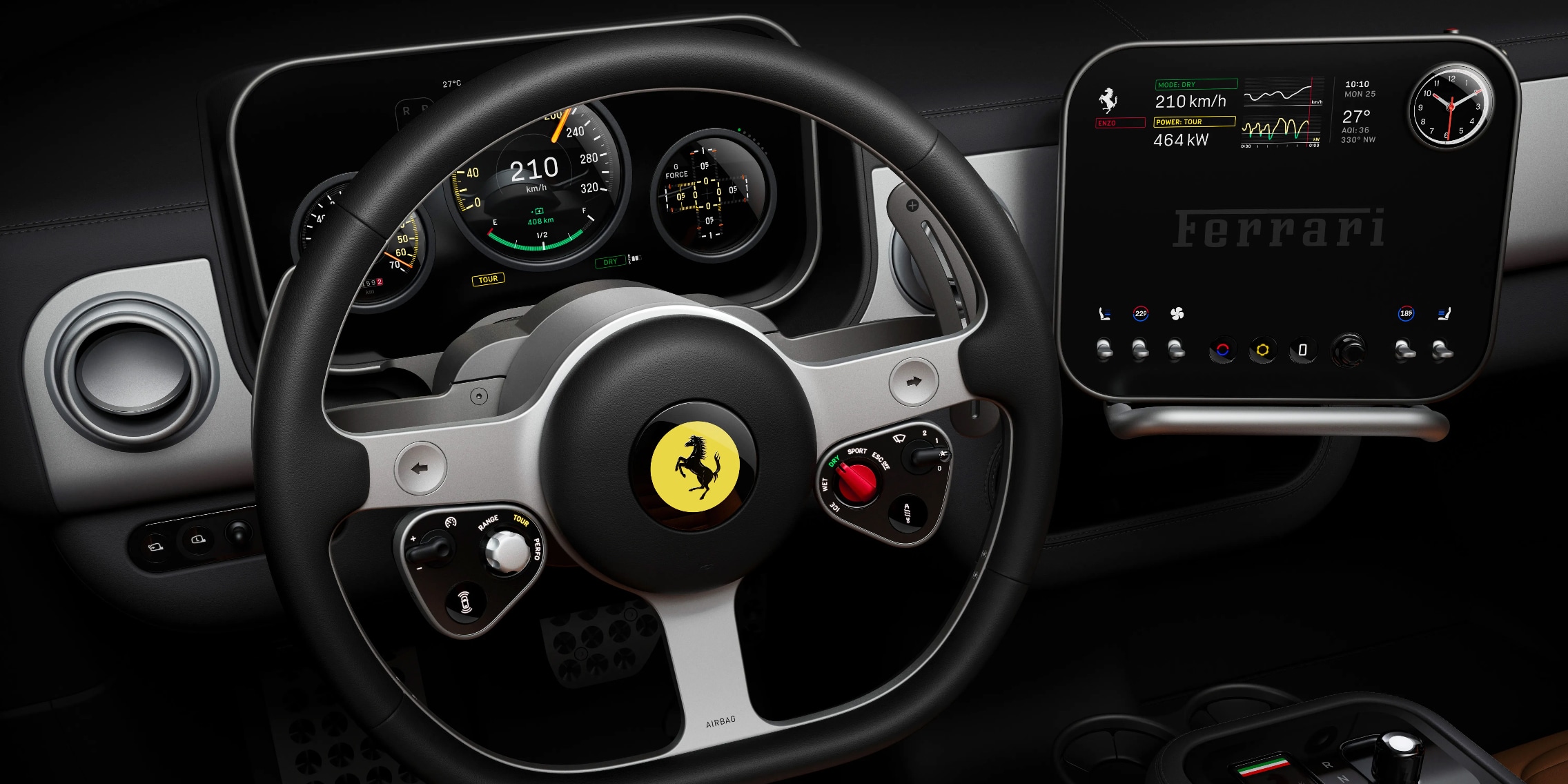
Perhaps the greatest irony of the Luce is its cabin. Sir Jony Ive — the designer who eliminated physical buttons from the iPhone, iPad, and Apple Watch — has designed an interior that deliberately rejects touchscreen-first thinking. Working through his firm LoveFrom alongside Marc Newson and Ferrari design chief Flavio Manzoni, Ive created a cockpit built around tactile, physical interaction.
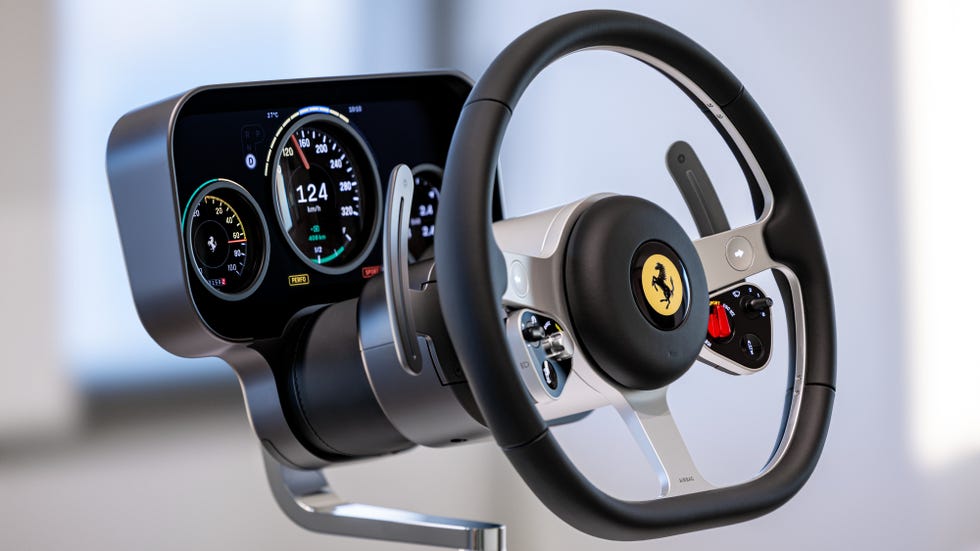
The three-spoke steering wheel is made from 100% recycled aluminium, consisting of 19 separate CNC-machined parts. The traditional Manettino dial sits on the right spoke for driving modes. A new eManettino on the left offers three EV-specific modes: Range, Tour, and Performance. Two paddles behind the wheel replicate manual transmission feel — the right paddle shifts between five torque levels, the left controls regenerative braking intensity.
The centre console features a Corning Gorilla Glass shift knob — hardened in a 400°C salt bath and drilled with 13,000 precision laser holes to reveal hidden illumination. The driver's glass key fob slots into the console, transitioning from yellow to black while the shift knob lights up. A 10.12-inch central screen sits on a ball-and-socket joint, pivoting between driver and passenger. Above the primary 12-inch gauge cluster, a mechanical multigraph with proprietary movement houses a clock, chronograph, compass, and launch control telemetry.
The Sound: No Fake V12, No Silence
Ferrari refused to simulate an engine sound. Instead, sound engineer Antonio Palermo — a guitarist who draws inspiration from Hendrix, Gilmour, and Jimmy Page — developed an amplification system that captures the actual vibrations of the rear-axle electric motors using accelerometers. These vibrations are filtered (removing gear whine) and amplified through cabin speakers, creating a sound that changes naturally with speed and torque.
"We are giving a voice to the first electric Ferrari," Palermo says. "We are letting the components speak for themselves." The concept mirrors an electric guitar: the motor is the string, the amplifier gives it voice. The driver can hear when left and right motors deliver different torque levels — authentic, functional feedback without a single synthesized note.
Chassis: The First Ferrari That Controls Every Wheel Independently
The Luce rides on Ferrari's Gen 3 active suspension — an evolution of the Purosangue and F80 systems. A 48-volt system with motor-driven recirculating ball screws reacts fast enough that anti-roll bars are unnecessary. Combined with four-wheel steering and per-wheel torque vectoring, the Luce is the first Ferrari where vertical, lateral, and longitudinal forces can be controlled at each individual wheel simultaneously — all managed by a single computer.
Seven drive modes range from Ice (maximum stability, all-wheel drive for low grip) to ESC-Off (only active suspension and front torque vectoring enabled, rear motors free for smoky drifts). Despite weighing approximately 2,300 kg, Ferrari claims the Luce will feel lighter and more agile than its mass suggests.
The Verdict: Is This Still a Ferrari?
The Luce is not a compliance car built to satisfy regulators. It is not a luxury golf cart with a prancing horse badge. It is a 1,000+ horsepower, rear-biased grand tourer with an in-house powertrain derived from F1 technology, an interior designed by perhaps the most important industrial designer alive, and a sound system that treats authenticity as non-negotiable.
Whether purists accept it or not, the Luce represents something unprecedented: a car that takes the electric formula — silence, instant torque, software-defined dynamics — and filters it through seventy-eight years of Maranello obsession with driver engagement. Torque shift paddles that mimic gear changes. A Manettino that still clicks. Regenerative braking that feels like engine braking. An ESC-Off mode that lets you drift.
First deliveries are expected in late 2026, with waiting lists likely stretching 12–18 months. Price starts above €500,000 before Tailor Made options push it significantly higher. The full exterior will be revealed on May 25 in Rome — and based on designer hints, it will be radical.
Enzo Ferrari once said that the engine is the heart of the car. The Luce has four. Whether that is heresy or evolution, we will find out in five weeks.